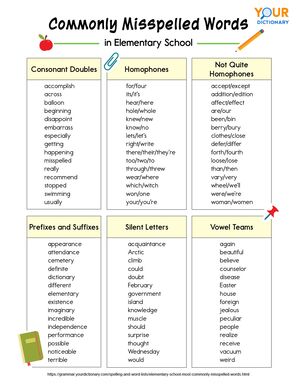

When elementary students are starting to read, they sound out the word they're reading. But this technique doesn't always work for silent letters, double consonants or homophone pairs. Review a few lists of commonly misspelled words with your elementary school students to ease some of these issues.
Most Commonly Misspelled Words in Elementary School
Learning the proper spelling rules for commonly misspelled words can prepare elementary students for a lifetime of spelling success. Take a look at several spelling lists, grouped by spelling issue, that can help elementary students master puzzling words.
Confusing Consonant Doubles
When do you double consonants in a word? How can you tell what consonants should be blended? Many commonly misspelled words in primary school involve consonant pairs. For example:
- accomplish
- beginning
- disappoint
- especially
- getting
- happening
- misspelled
- recommend
- stopped
- usually
Hard-to-Remember Homophones
Elementary students (and even older readers) struggle with homophones because they sound the same but are spelled differently. Keep those homophone sets straight with these spelling words.
- its/it's
- hear/here
- knew/new
- know/no
- right/write
- there/their/they're
- too/two/to
- through/threw
- won/one
- your/you're
Not Quite Homophones
Some words, such as dessert and desert, are almost homophones — but not quite. They sound just similar enough to be confusing. Clear up their spelling differences with a list of commonly misspelled elementary words that sound almost the same.
- accept/except
- addition/edition
- affect/effect
- clothes/close
- defer/differ
- forth/fourth
- loose/lose
- than/then
- vary/very
- woman/women
Advertisement
Puzzling Prefixes and Suffixes
Adding an affix to a word can often make it harder to spell. Challenge elementary learners to choose the correct spelling for the following words with prefixes and suffixes.
- attendance
- cemetery
- dictionary
- existence
- imaginary
- independence
- performance
- possible
- noticeable
- terrible
Sneaky Silent Letters
Elementary readers might know about the silent "e," but what other letters can be silent in a word? Work on these commonly misspelled words with silent letters.
- acquaintance
- could
- February
- government
- knowledge
- muscle
- should
- surprise
- thought
- would
Vexing Vowel Teams
Elementary spellers often mix up the order of vowel teams or diphthongs. Keep those vowels in place with some practice spelling words.
- beautiful
- believe
- disease
- Easter
- foreign
- jealous
- people
- realize
- receive
- vacuum
Advertisement
Printable List of Commonly Misspelled Words
Review and download the printable list of commonly misspelled words. It's a great reference resource to keep on hand in the classroom.
Teaching Strategies for Spelling
Spelling lessons don't need to be difficult for students — or for teachers. Use these tips for teaching spelling in the classroom.
- Be patient with students. Learning to spell is a gradual process.
- Even older learners can benefit from the usage of flashcards.
- Encourage the occasional use of spell check on the computer. Spell check should not become the ultimate source for students, but it allows students to see the word in front of them.
- Distribute handouts that have both the correct and incorrect spellings of words on them. Allow students to figure out which one is correct.
- Ask students which words they have trouble spelling, and write them on the board. Make a class list of commonly misspelled words for students to reference.
- Be sensitive to learning disabilities. Spelling words correctly is going to be much more difficult for someone who has difficulty with reading or processing.
- Encourage students to edit their own work. If they learn to pick up on their own errors, they will be more likely to correct them.
Advertisement
Practice Makes Perfect
Many problematic words don't make a lot of sense because they don't follow conventional rules about how words should be spelled. The more students work on the words that give them trouble, the faster they can overcome these challenges. For more spelling practice, use a few tips to improve spelling in the classroom.