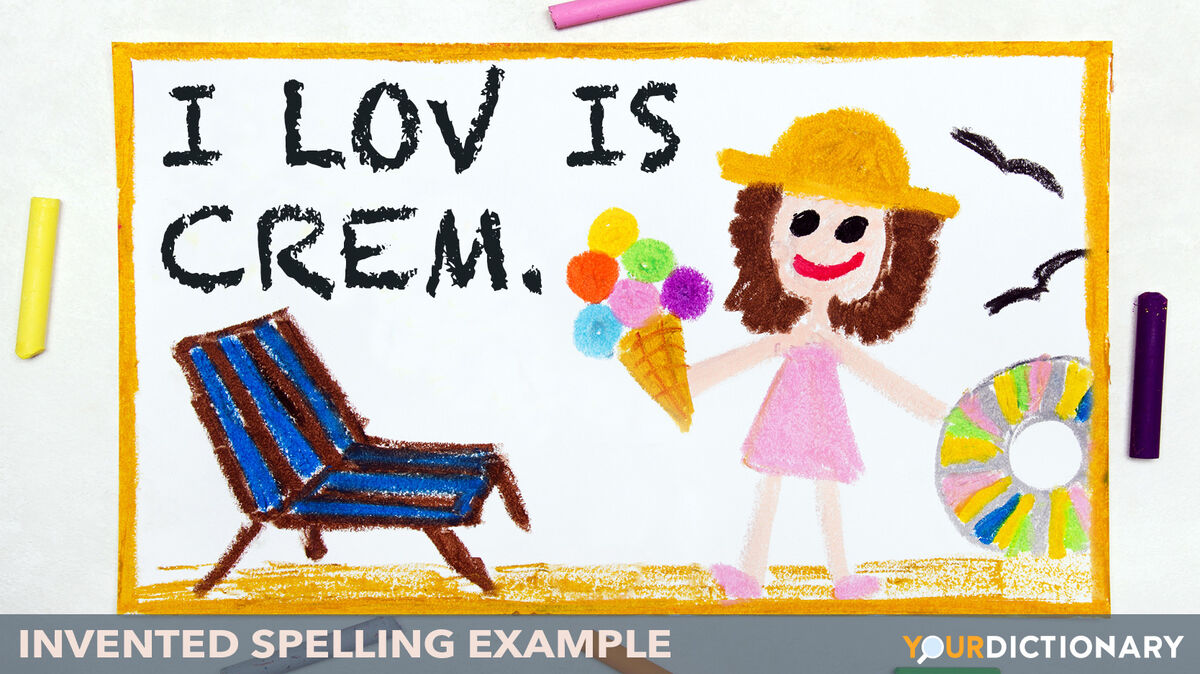
When you live in a world filled with LOLs and BRBs, it’s not surprising to see many words with invented spellings. The trouble is, no award-winning author actually thought “tho” was the correct way to spell “though.” So, does invented spelling fit anywhere into the learning process? The honest answer is yes. Invented spelling isn't something that can be totally avoided. In fact, it's a natural part of developing spelling skills. Take a look at how to incorporate this simple fact of life into your next spelling lesson.
About Invented Spelling
Invented spelling, sometimes referred to as inventive spelling, is the practice of spelling unfamiliar words with an educated guess based on phonetic knowledge. Examples of invented spelling include:
- "iz" for "is"
- "flawrs" for "flowers"
- "is cream" for "ice cream"
- "lov" for "love"
- "prpul" for "purple"
- "culrs" for "colors"
- "difrint" for "different"
Invented Spelling Research
In 1975, linguist Charles Read conducted a study of preschoolers who were beginning to relate letter names to the sounds of the alphabet. He discovered that students commonly "invented" spellings for words in their daily vocabulary by rearranging letters to fit their perception of the rules of the English language.
Read concluded, "One sees clearly that different children chose the same phonetically motivated spellings to a degree that can hardly be explained as resulting from random choice or the influence of adults." A key takeaway from this study is that learning how to spell is much more than just memorizing words. It's a developmental process that goes far beyond just exploring the relationships between the symbols used to illustrate speech sounds. Thus, the process of invented spelling can play an important role in leading young learners to develop a deep, phonetically-based understanding of how to spell many words.
Key Considerations for Invented Spelling
Many teachers consider invented spelling to be a developmentally appropriate step in the early stages of a child’s reading and writing. Proponents argue that invented spelling does not interfere with a child's ability to spell correctly in later years.
Invented spelling can be compared with the efforts a child makes when first learning to speak. A parent wouldn’t criticize a child's first attempts to reproduce the sounds of the verbal language. Accordingly, a child's efforts to master written communication skills should also be encouraged. After all, young learners have to start somewhere.
The Advantages of Invented Spelling
It's important to note that, from a technical standpoint, invented spelling is not an instructional technique. It’s merely a natural process that all children use as they’re beginning to write. There are advantages to incorporating invented spelling into the classroom. When monitored closely, it can offer a number of benefits for blossoming spellers.
- Invented spelling can help build a sense of confidence, pride and control over the learning process.
- It allows students to express themselves creatively through writing without worrying about the spelling of unfamiliar words.
- Writing using invented spelling techniques allows for extensive practice of phonics because students are using letters to represent the sounds they hear.
- Teachers can discover important information about a student's growing knowledge of phonemes by reading a composition that the student created using invented spelling techniques.
The Disadvantages of Invented Spelling
In a classroom where invented spelling is allowed, a teacher wouldn’t deduct points from the student's grade for misspelled words in a composition. The potential disadvantages of allowing invented spelling are probably what you’d expect.
- It may reduce the incentive for children to learn to spell words correctly.
- It could possibly lead to problems in communication since others may not always be able to decipher what the student has written.
- Highly logical children may become frustrated when the teacher doesn’t insist there’s only one correct way to spell a particular word.
Using Invented Spelling to Encourage Reading and Writing
Learning to spell, just like learning to speak, is an ongoing process. There are a few important tips to keep in mind if you are a parent or teacher of a child in a school where invented spelling is encouraged.
- Provide writing opportunities on a regular basis. At home, parents can encourage children to help prepare shopping lists, write letters to grandparents or make up a story for a younger sibling.
- Resist the urge to criticize or point out mistakes with what the child writes. The goal of invented spelling is to promote creative expression.
- Refer to the child's creative spellings by the title of "invented spelling" to help distinguish them from the correct conventional spelling.
- Ask children to read their writing aloud. This will help you decipher how they have spelled words while also giving them reading practice.
- Be sensitive to the struggles children face as they seek to master the written component of the English language.
Beyond Invented Spelling
As young learners start to move beyond invented spelling to mastering correct spelling, your approach to helping them build skills will need to change. Get ready to help your little learners build on their earliest spelling and writing skills. Start by learning how to teach sight words by grade level. Then, get ready to share fundamental spelling rules for everyone to know. Use fun spelling activities to help young learners build strong skills they'll be able to expand upon over time.