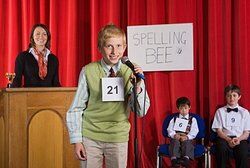
Do you see any spelling bees in your students' future? How about THE spelling bee, Scripps National Spelling Bee? It’s the nation’s oldest and most iconic competition. In 2004, world-class spellers were given a treat. Scripps released a consolidated word list encompassing almost every word from prior spelling bees. That’s an excess of 23,000 words!
One of the best ways to prepare your spellers is to start small with weekly classroom spelling bees. Then, in time, they can advance onto regional and even national spelling bees. This type of skill will foster a strong sense of self-confidence in students and will spark a lifelong love for reading and writing.
The Scripps National Spelling Bee CWL
Although Scripps’ 2004 Consolidated Word List (CWL) hasn’t been updated since then and is no longer published on their site, you can still access its wealth of words online. If you're hoping to help your child or student capture his or her first spelling bee trophy, the Scripps National Spelling Bee CWL is a great place to start. You can get a feel for the type of words judges have historically quizzed their spellers with.
Word Lists for Spelling Study
The process of preparing for the Scripps Spelling Bee is quite rigorous. It's common to hear students say they study words for several hours per day, reading obscure literary texts to develop their vocabulary skills, or quizzing each other straight out of the dictionary.
If you're interested in having more words to study, there are several ways to obtain study word lists:
- Start your spelling sessions with YourDictionary’s list of Spelling Bee Study Words.
- Mental Floss has a fun article, detailing 20 winning words from past National Spelling Bees. These include “albumen” from 1928 and “chiaroscuro” from 1998.
- YourDictionary provides a variety of word lists, including alphabetical lists of adjectives, nouns, and verbs. We go through each letter of the alphabet with long lists to practice all manner of common and uncommon words.
- If you really want to turn up the heat, check out this list of every word that was misspelled during the 2019 Scripps National Spelling Bee. Would you have known how to spell parturition or solipsistic?
- On a more positive note, here’s a list of the winning word from every Scripps Spelling Bee since 1925. Can you believe “croissant” was the winning word in 1970? That seems a tad bit easier than "staphylococci" from 1987!
- Finally, take a look at some of the winning terms from former spelling bees. People points out some of the strangest terms, including aiguillette, bougainvillea, and pendeloque.
For a bit of fun, check out this list of the Longest Words in the English Language. "Hippopotomonstrosesquipedalian" seems particularly appropriate. It's defined as "pertaining to really long words."
Scripps National Spelling Bee Competition
The Scripps National Spelling Bee started in 1925. It's a competition run on a not-for-profit basis by the E. W. Scripps Company in conjunction with local sponsors.
- Study Words: If your school is enrolled, you can receive study words for each grade level. Simply register online, pay the enrollment fee, and you’ll have access to 100 study words prepared for grades 1-8.
- Eligibility: The Bee is open to students who haven't passed beyond the 8th grade and are winners of sponsored American regional spelling bees as well as the top young spellers from Canada, Mexico, Jamaica, New Zealand, and the Bahamas.
- Timing: Every fall and winter, schools have local competitions. They then send their winners to the next level of competition.
- Event: The event is televised and takes place in Washington, D.C.
- Prizes: The winner of the Scripps National Spelling Bee receives a $40,000 cash prize and engraved trophy, along with a selection of reference books from Merriam Webster and Encyclopedia Britannica. Pizza Hut will also throw a pizza party at the champion's school. Smaller awards are given to top-ranking finalists in the competition. For example, there's a $30,000 cash prize for second place and a $20,000 cash prize for third.
- Scripps publishes the Bee's Great Words, Great Works reading list to get students excited by suggesting engaging, age-appropriate books.
What a Claim to Fame
Imagine winning a $40,000 cash prize before you've even entered the 8th grade? That's a terrific springboard for a future at any number of prestigious universities.
But, let's not get ahead of ourselves. Participating in a spelling bee is a great confidence builder, no matter where you rank among the finalists. The best part is that top-notch spelling skills go hand-in-hand with a lifelong love for reading, and fewer things in life are more precious than that.