Learning a word's meaning is just one part of understanding that word. Once you know a word's antonyms, synonyms and homonyms, you can add a lot of variety to speech and writing. But what are synonyms and antonyms, and what do they have to do with homonyms? Learn more about each type of word and how they can help increase your vocabulary.
What Are Synonyms?
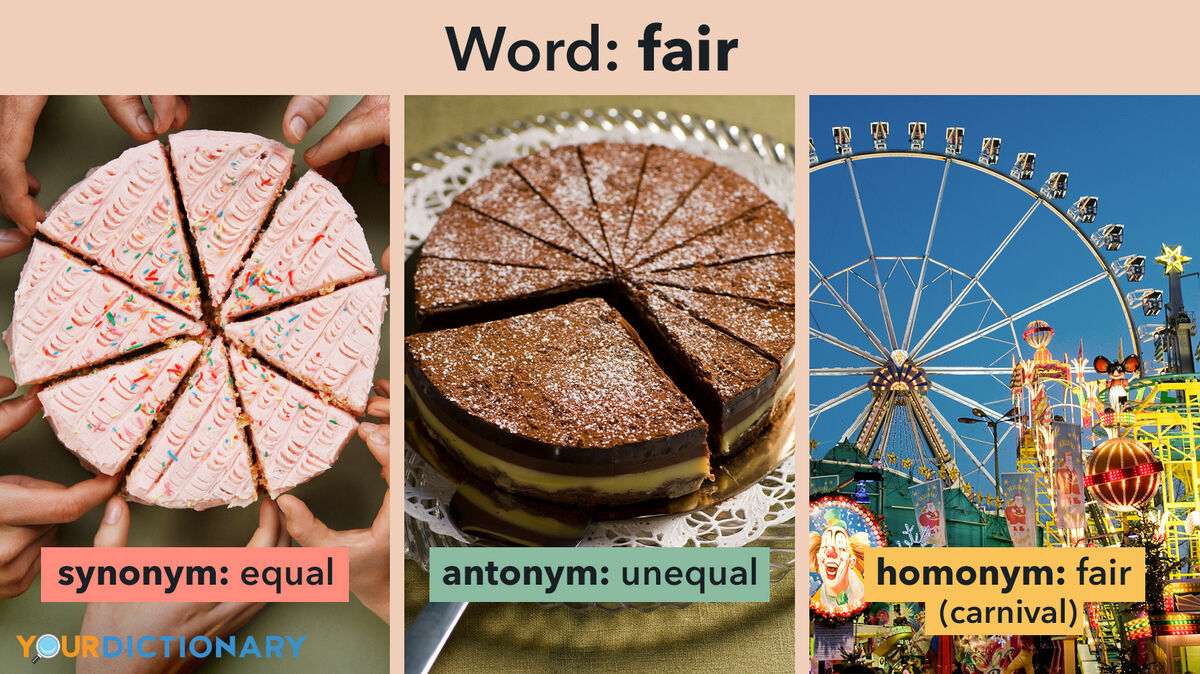
Synonyms are words that share meanings with other words. They are used to add variety to writing and speech and allow you to avoid repetition. The words amazing, astounding and marvelous are all synonyms. Their meanings are similar and can be interchanged with one another.
Synonyms must be the same part of speech. For example, beautiful and princess have the same connotation of beauty, but they are not synonyms because beautiful is an adjective and princess is a noun.
Examples of synonym pairs include:
- skill and ability
- lead and guide
- guest and visitor
- love and adore
- angry and furious
Synonyms make it possible for writers to create a certain mood with their subtle differences. For example, the verb "walk" sets a different pace than "saunter," and "drink" implies a different style than "guzzle." The differences are implied by the word selected, and when a writer is trying to paint a picture in a reader's mind, those differences can make or break a writer's prose.
What Are Antonyms?
Words with opposite meanings are called antonyms. Like synonyms, antonym pairs must be the same part of speech. Antonyms show a contrast between two ideas.
Examples of antonym word pairs are:
- full and empty
- fail and succeed
- happy and sad
- tiny and enormous
- wonderful and terrible
Some common prefixes indicate that a word is an antonym to its root word. For example, the prefixes un- (unhappy, unwise), dis- (disinterested, dislike) and im- (improper, impolite) form a new word that is the opposite of its root word.
What Are Homonyms?
Homonyms are words that have the same spelling and pronunciation but different meanings. Because these words sound and look the same but mean something different, they can be a source of entertainment, confusion or even inspiration. Many puns are inspired by homonym mix-ups!
Some common homonyms include:
- bat - an implement used to hit a ball (such as a baseball bat) or a nocturnal flying mammal (such as a fruit bat)
- bear - a hibernating animal (such as a grizzly bear) or to carry something (such as bearing children)
- fire - a flaming blaze (such as a forest fire) or to terminate someone from a job (such as firing an employee)
- trip - to stumble or fall (such as tripping on a curb) or a vacation (such as a summer trip)
- watch - a wearable timepiece (such as a wristwatch) or to look at something (such as watching television)
Homonyms are often confused with homophones, which have the same pronunciation but are spelled differently, and homographs, which are pronounced differently but are spelled the same. It's helpful to know any homonyms to a word that you're learning in order to avoid word mix-ups in the future.
Advertisement
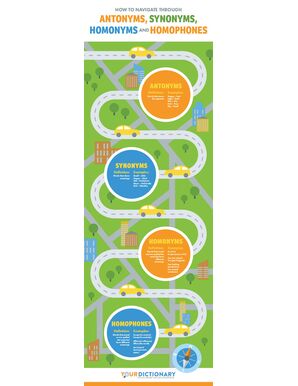
Navigate Through Word Relationships
Still doubting whether you know the difference between these different types of word relationships? Download and print the PDF below for a handy reference guide for confusing word choices.
Learning antonyms, synonyms and homonyms can be tricky, but having a few in your language belt will certainly help expand your vocabulary. Using a variety of these words will make your speech and writing more vivid and exciting, and can help you avoid being repetitive or stale.
Master Word Meanings With Frayer Squares
Now that you know what synonyms, antonyms and homonyms are, you can use them to practice new vocabulary words. An effective vocabulary strategy is the Frayer Square, which prompts students to draw a square with the new word in the middle. They divide the square into four sections, which are labeled:
- definition - meaning of the word
- synonyms (or examples) - three or more words with the same meaning
- antonyms (or non-examples) - three or words with the opposite meaning
- picture - a picture that reminds the student of the word's definition
These exercises are helpful for English learners, students learning advanced vocabulary or professionals trying to acquire very technical knowledge. Try them out — you may even prefer them to flashcards!
Advertisement
Playing With Your Vocabulary
Understanding how words relate to each other is a key part of making connections in language arts. Once you can navigate these word systems, you'll easily expand your vocabulary. Check out more examples of antonyms, synonyms and homonyms to learn more about these concepts. If you'd like a simpler version of these differences, take a look at examples of word relationships for kids.