If you compare action vs. non-action words in a sentence you can easily see the difference. Following are explanations of these types of verb, reasons to use one or the other, and lots of examples.
Verbs to Express Action
Action words, or action verbs, simply express an action. The action is something the subject of the sentence or clause is doing and includes sleeping, sitting, and napping—so even though there is no movement, there is still an action. Other examples are:
- Crawl
- Decorate
- Jump
- Haunt
- Kick
- Entertain
- Walk
- Follow
- Growl
- Yell
- Listen
- Eat
Verbs to Express Being
Non-action words, or non-action verbs, do not refer to an action as such, but represent a state of being, need, opinion, sense, or preference. Examples are the “be” verbs, like: am, are, was, were, is, has been, and had. Referring to the senses, some non-action words are: look, smell, feel, taste, and sound.
More examples of non action words are:
- prefer
- like
- love
- want
- need
- appear
- seem
- possess
- belong
- believe
- consider
- own
Active vs. Passive Voice in Writing
When you are writing, you have to choose between using action or non-action words. This decision will depend on what kind of writing you are doing. When you write in the active voice, it adds impact to your writing and makes it stronger. Your sentences will be more positive and concise. Using action words is part of the process of active writing, where the subject is doing the action. When you use the passive voice, the action is done to the subject. Using non-action words, your sentence is less dynamic. Here are some examples:
- Active: The kids ate the cookies.
Passive: The cookies were eaten by the kids. - Active: Mary guided the tourists.
Passive: The tourists were guided by Mary.
You can see from these sentences that the active voice is more direct and strong, whereas the passive voice is weak and less concise. The passive voice in writing can also be confusing to the reader, because it is not precise and uses more words. Many times the passive voice is awkward because you have to work harder to figure out who did what. It can also be vague and is often used a lot by politicians, businesses, and advertisers to obscure facts and place blame elsewhere. For example:
- Mistakes were made. (By whom?)
- Your service will be interrupted. (Not, We will interrupt your service.)
If you are writing a mystery story or novel, you may want to be deliberately vague. You may want to place emphasis on “the painting that was taken” rather than on who is responsible, as you won’t reveal that information until later in the book or story. Crime reports often have to be written in the passive voice because all the facts are not available. You would have to say “the store was robbed” if you don’t know who did it yet.
Another place that the passive voice may be used is in reporting on scientific findings. The passive voice will keep the author’s opinions out of the writing, so the sentence may read like this: "Data supports the theory that this disease is caused by bacteria XYZ." That is better than saying: "I think that bacteria XYZ caused the disease."
Test Your Knowledge
Five of the following sentences are active and five are passive. Remember that the state of being verbs (are, am, were, is, was, and has been) are used in passive sentences. Also to identify an action word pay attention to the person or thing doing the action.
- Tom walked to the park.
- The horse is being brushed by Sarah.
- I ran all the way home!
- His new kite was broken.
- Is your dad going to the movie?
- Information was discovered yesterday.
- Our snowman is melting.
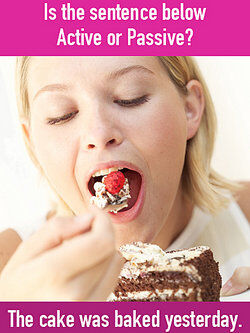
- The cake was baked yesterday.
- I can’t decide what to do.
- That play has been seen by thousands of people.
Answers: The odd numbered sentences are active, and the even numbered ones are passive.