Have you ever gotten a paper back from a teacher with "passive" written in red ink? If so, you may be writing in passive voice without knowing it. Keep reading for quick active to passive voice converter tips and other ways to make voice change easy.
Defining Active and Passive Voice
You may already know the difference between active and passive voice. But here's a refresher:
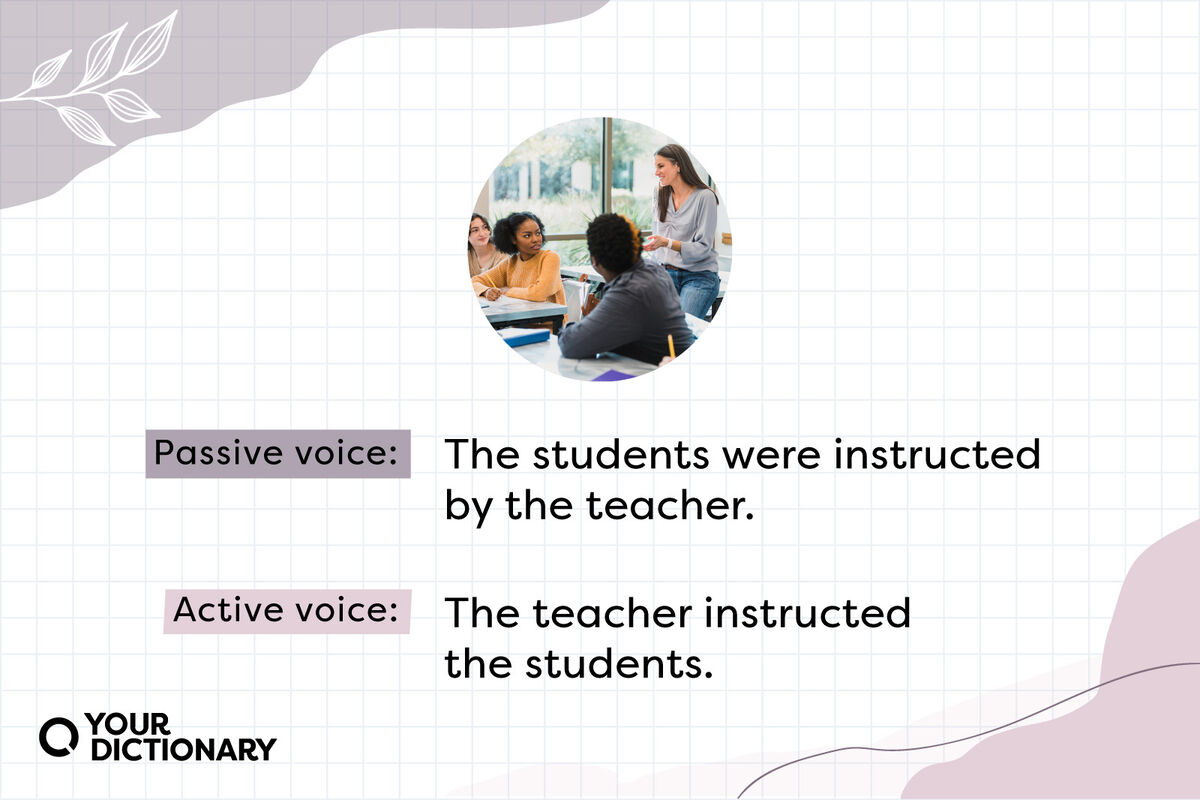
- Active voice - the subject performs the verb's action. (For example: Tom changed the flat tire.)
- Passive voice - the subject receives the verb's action. (For example: The tire was changed by Tom.)
Generally, in active sentences, the subject comes before the verb. In passive sentences, the subject comes after the verb. Writing sentences in passive voice can obscure the subject of the sentence and confuse the reader. The good news is that it's quite easy to change the passive voice to the active voice.
How to Change Voice from Passive to Active
If you can find the subject and verb in a sentence, you change the voice in your sentence. Let's use the following example to understand how to change passive voice to active voice: "The children were instructed by the teacher." Use these steps to work your sentence through a passive to active voice converter.
Step One: Find the Action of the Sentence
What action is happening in the sentence? Someone (the subject) is instructing someone else (the object). The past tense verb instructed is part of the verb phrase were instructed in this sentence.
Step Two: Find the Subject of the Sentence
In passive sentences, the subject may end up at the end of the sentence, or it may be missing altogether. The person instructing, the teacher, comes after the verb. If it were missing from the sentence, it would read "The children were instructed."
Advertisement
Step Three: Put the Subject Before the Verb
Once you've found the subject and the verb, put them together. So far, you've got "The teacher were instructed." But that doesn't sound right. Fix the verb tense to say "The teacher instructed."
Step Four: Put the Object Where It Belongs
Who did the teacher instruct? The children receive the action (instructing) in this sentence, making "the children" the object. Put the object right after the verb where it belongs: "The teacher instructed the children." Now you have a sentence in active voice!
Getting Rid of Extra Word(s)
Your new sentence is five words long, but your original sentence was seven words long. Where did those extra two words go?
Passive sentences often include extra words to force the subject to the back of the sentence. These words typically include all forms of the verb "to be," such as "was," "is," "have been," and "will be." Sentences that include the subject may also include the preposition "by." Both "were" and "by" were unnecessary words in the original sentence.
Advertisement
Practice Changing Passive to Active Voice
Try a new sentence with the same steps. For example: "The money has been stolen by the criminals."
- Find the action (verb phrase): has been stolen.
- Find the subject (who stole it?): the criminals.
- Put the subject before the verb (and fix the tense): The criminals have stolen.
- Add the object (what was stolen?): The criminals have stolen the money.
Now your sentence is in active voice. Correct the following five sentences to practice changing passive to active voice (answers are below).
- The jar is filled by the falling sand.
- Reading is enjoyed by Mary.
- The town was destroyed by fire.
- The room will be cleaned by John every Saturday.
- Cheese was eaten by Sara.
Print a Passive-To-Active Reference Guide
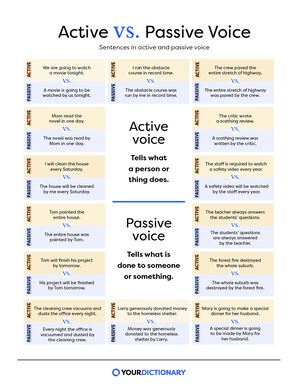
The best way to learn voice change rules is to see lots of examples. That includes examples of both active and passive voice. If you'd like more examples of both voices, download and print the handy reference guide below.
Advertisement
Answers to Practice Sentences
- The falling sand fills the jar. (The falling sand is the subject, fills is the action)
- Mary enjoys reading. (Mary is the subject, enjoys is the action)
- Fire destroyed the town. (Fire is the subject, destroyed is the action)
- John will clean the room every Saturday. (John is the subject, clean is the action)
- Sara ate the cheese. (Sara is the subject, ate is the action)
Be in Control With Active Voice
Feel like you're getting the hang of it? That's great! This is one of the most important rules for English writing. Before you close the book on the subject, learn more about how active voice adds impact to your writing so you're fully in control of your sentence structure. And if you're in need of active to passive converter help, check out those times when it's actually okay to use passive voice.