
There, their and they’re are short words with different meanings. Many new and experienced English speakers mix these three words up, but with a little practice, you can get them straight. Keep reading for a basic overview of their, they're and there and challenge yourself with a grammar worksheet.
The Difference Between There, Their and They’re
There, their and they’re are homophones. That means they sound the same but have different meanings and spellings. Once you know the rules for using there, their and they're, finding their differences isn't so hard. Consider the following definitions and sample sentences to help you understand the difference between these three words.
- there - that place, the opposite of here, referring to a specific item (Please put the glasses there.)
- their - it belongs to them (The Smith family leased their car.)
- they're - they are (They're going on vacation next summer.)
The best way to really know the difference between they're, there and their is to read a lot of books that use the words correctly. You can also get some extra practice with these helpful their, there and they're worksheets.
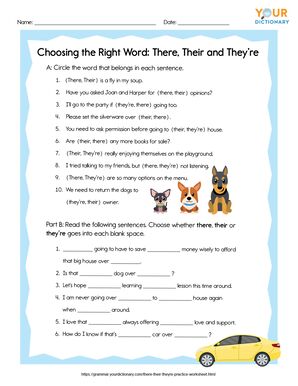
Choosing the Right Word: There, Their and They’re
Ready for some there/their/they're practice questions? Try a few exercise questions now, then print a full worksheet to keep learning.
Choosing the Right Word Practice Questions
For each sentence below, fill in the blanks with either their, they're or there — whichever is the correct usage. Find the answer key below. Good luck!
- ____ going to have to save ____ money wisely to afford that big house over ____.
- Is that _____ dog over _____?
- Let’s hope _____ learning ____ lesson this time around.
- I am never going over _____ to _____ house again when _____ around.
- I love that _____ always offering _____ love and support.
Printable Worksheet for Choosing the Right Word
If you'd like more practice on the concept, download and print the full version of the worksheet. It includes more grammar exercises and an answer key for easy grading.
Advertisement
Answers for Choosing the Right Word Practice Questions
How did you do? Check your answers for the exercises above.
They’re going to have to save their money wisely to afford that big house over there.
Is that their dog over there?
Let’s hope they’re learning their lesson this time around.
I am never going over there to their house again when they’re around.
I love that they’re always offering their love and support.
Tips for Mastering They're, There and Their
To master the difference between these terms, there are several different ways to turn practice into perfection.
- Put pen to paper. See if you can create your own sentences, using there, their and they’re. Talk about “their cool pencil case” or mention that the teacher’s dry erase marker is “over there” in a short story of your own creation.
- Read your sentences aloud. Go back and read each of the above sentences out loud. Pay attention to each word’s usage in proper context. Although the words will always sound the same, reading them aloud will help you visualize “their” to indicate possession and “there” to indicate “that place over there.”
- Read a wide variety of content. Truth be told, there’s no better way to become an English language expert than to read. Read as many books, magazines and blogs as you possibly can. You’ll notice how words are used in their proper context and even when something seems to be written in error.
- Listen to speech. Have a friend or family member read you a sentence out loud using one of these words, and see if you can use what you’ve learned about each word and context clues to identify whether there, their or they’re is used.
If you'd like to spend some more time with these three troublesome words, try reading examples of sentences that use there, they're and their. They make great review activities for you or others who want to write these words correctly.
Advertisement
Homophones Make Our Language Musical
Even though it can be frustrating to learn they're, there and their, it's an important step to mastering the finer points of the English language. However, these three words aren't the only commonly confused words for writers! Refresh your memory on to vs. too when you're ready for a new challenge, or learn whether you should use all right or alright in your next writing assignment.
