Finding the plural versions of singular regular verbs isn't too complicated — if you know how to make them plural. It gets a little trickier when you add irregular verbs into the mix. Take a look at an explanation of singular and plural verbs, as well as a singular and plural verbs list that focuses on common regular and irregular verbs.
Singular vs. Plural Verbs
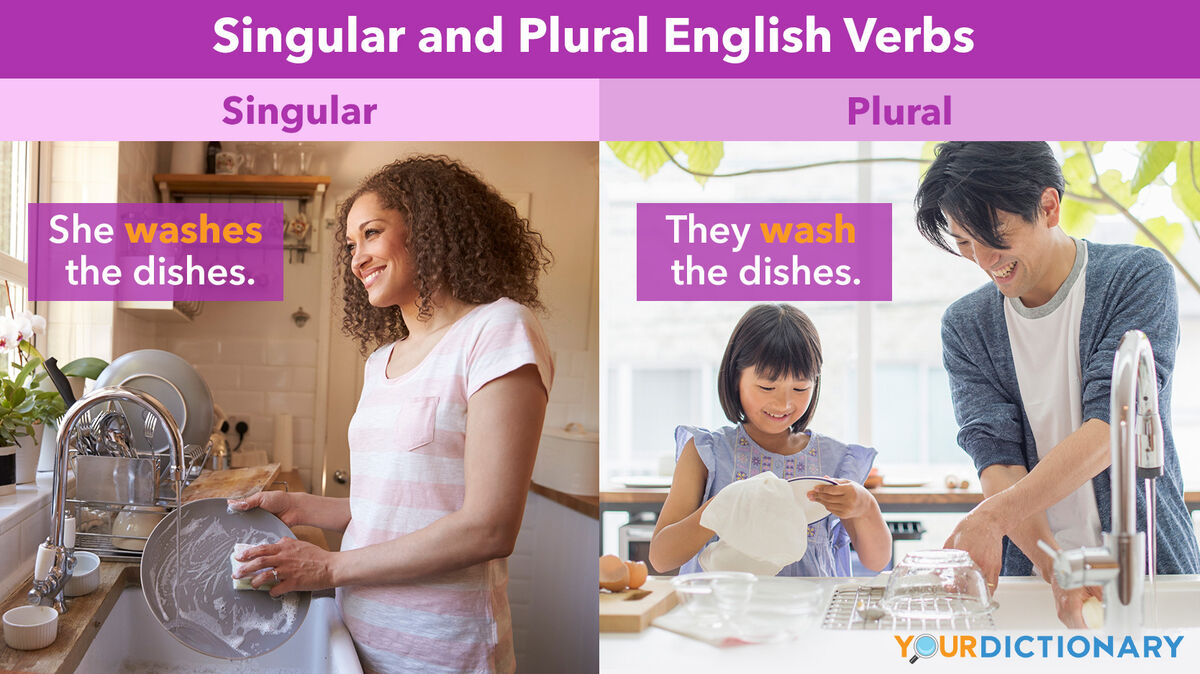
According to the rules of subject-verb agreement, the verb in a sentence must match the subject. In other words, if one person is performing an action, the verb is singular. If more than one person or object are performing an action, the verb is plural. The rules for making singular verbs plural are:
- Singular verbs - add -s or -es (he bakes, she walks, Michele washes)
- Plural verbs - don't add -s or -es (they bake, we walk, the Hamiltons wash)
Use singular verbs for third-person nouns and pronouns (he, she, it), as well as collective nouns such as "team" or "family." When you use the pronouns I and you, use the base form of the verb (I bake, you bake), just like you do for plural verbs.
Printable Irregular Singular and Plural Verbs List
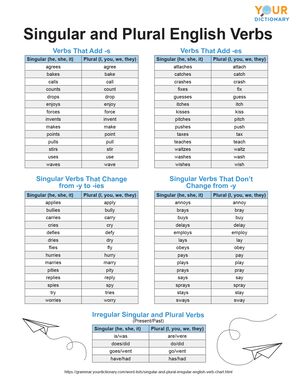
Looking for a printable chart of common irregular verbs? Included below is a list for reference or to post in a classroom.
Singular Verbs That Add -s
Most regular verbs can be made singular by adding -s only. Some of these verbs include:
- Singular - Mary bakes cookies.
- Plural - Mary and her sister bake cookies.
- Singular - Shawn agrees with the plan.
- Plural - Shawn and Emily agree with the plan.
- Singular - The witch stirs the potion.
- Plural - The witches stir the potion.
Singular Verbs That Add -es
Some verbs add -es when changed to a singular form from the base form. These verbs typically end in -ch, -o, -s, -sh, -x, or -z. They include:
- Singular - He always catches the ball.
- Plural - They always catch the ball.
- Singular - Harvey teaches second grade.
- Plural - Harvey and Lilith teach second grade.
- Singular - My brother always pushes me around.
- Plural - My brothers always push me around.
Advertisement
Singular Verbs That Change From -y to -ies
Verbs that end in a consonant and -y change to -ies in singular form. For example:
- Singular - The parrot flies around the room.
- Plural - The parrot and the cockatiel fly around the room.
- Singular - Charlotte cries when she watches sad movies.
- Plural - Charlotte and Olivia cry when they watch sad movies.
- Singular - My mother worries when I stay out late.
- Plural - My parents worry when I stay out late.
Singular Verbs That Don't Change from -y
There is a small group of verbs that end in -y but don't change to -ies. That's because they end in a vowel and -y, not a consonant and -y. In these cases, you only add an -s. For example:
- Singular - Rude behavior annoys me.
- Plural - Rude behavior and language annoy me.
- Singular - Noel plays quietly with the dollhouse.
- Plural - Noel and her sister play quietly with the dollhouse.
- Singular - My dog obeys my commands.
- Plural - My dogs obey my commands.
Advertisement
Irregular Verbs Change Form
These rules work well for regular verbs, but what about irregular verbs? Irregular verbs are verbs that change form in the past tense, such as "catch" (caught) and "swim" (swam). Most of these verbs do follow the above rules, but there are a few that also change form in the singular present tense. These verbs include:
| Base Form | Singular | Plural |
| to be | is | are |
| to have | has | have |
There are only a few verbs that fall into this category, but they're very important. The verbs "to be" and "to have" are fundamental to the other verb tenses in English.
Singular and Plural Verbs in Other Tenses
Deciding whether a verb is plural or singular mostly happens when you're writing in the present tense. Regular past tense verbs (and most irregular past tense verbs) are the same for both singular and plural subjects. For example:
- Singular regular - My mom helped me.
- Plural regular - The neighbors helped me.
- Singular regular - Dave played football.
- Plural regular - Dave and Miles played football.
- Singular irregular - She came to the party.
- Plural irregular - We came to the party.
- Singular irregular - He sold my motorcycle.
- Plural irregular - They sold my motorcycle.
When you're writing in the progressive or perfect tenses, the main verb doesn't change with singular or plural subjects — but the linking verb does. For example, in the progressive tenses, the verb "to be" changes with the subject:
- Singular present progressive - Peter is running in a marathon.
- Plural present progressive - His brothers are running in a marathon.
- Singular past progressive - The car was working yesterday.
- Plural past progressive - The cars were working yesterday.
In the present perfect tense and the present perfect progressive tense, the verb "to have" must match the singular or plural subject:
- Singular present perfect - She has graduated from college.
- Plural present perfect - Her friends have graduated from college.
- Singular present perfect progressive - The dog has been barking for hours.
- Singular present perfect progressive - Both dogs have been barking for hours.
Sentences in the past perfect tense and the past perfect progressive tense use "had" along with the main verb, no matter whether the subject is singular or plural.
Advertisement
Embrace Singular and Plural Verb Forms
Using the correct verb form for subject-verb agreement makes your writing easier to understand. The more you review these verb forms, the more you'll spot them in everyday language and be better prepared you'll be to use them effectively. If at any point, you start to get turned around, you can always review these rules for conjugating verbs.