
Anyone can improve their vocabulary any time, anywhere with fun activities. Start by assessing your vocabulary skills, then look for quick and easy vocabulary strategies that fit your learning style, schedule, and grammar needs.
Read Vocabulary Books
One of the best ways to improve your vocabulary quickly is by reading books dedicated to vocabulary enhancement and expansion. Some of the best vocabulary books are unique dictionaries and thesauruses or even novels that use a lot of different words.
Read Outside Your Preferred Genre
Reading for pleasure is one of the most enjoyable and useful ways for how to expand your vocabulary. By exposing yourself to new and varied reading material, you'll inevitably come across words that are new to you. To challenge yourself, read popular books you wouldn’t normally pick up.
Use Context Clues
See if you can figure out the meaning of new words based on context clues, or the text around them. Then, double-check your understanding by looking the word up to make sure you were correct. If you prefer not to interrupt your reading time, you can highlight words for later or jot them down in your personal vocabulary notebook.
Learn About Root Words
Over half of English vocabulary is derived from either Latin or Greek. This means that if you broaden your understanding of these root languages, you can more easily figure out what new words mean.
The real fun of learning more words is knowing where a word comes from, how it found its way into the English language, and what its roots are. You can get started on a formal study of root words by checking out and memorizing a list of common roots, prefixes and suffixes.
Advertisement
Root Word Example
Take a look at the words “culpable” and “culprit.” These words share a similar root in "culp." Have you ever heard the phrase, mea culpa? It simply means "my fault" in Latin. Both "culpable" and "culprit" derive from that single expression.
A person who commits a mistake (or is at fault) is a culprit; the punishable offense is the culpable offense, related to guilt and fault. As you can see, learning one root word can help you learn many more words that derive from it.
Practice Word Association
Word association involves linking one word to something it automatically reminds you of. This type of mnemonic word association is a great memory trick for remembering not just new vocabulary, but also people's names. Having the associated words helps trigger your memory by activating similar neural pathways.
Advertisement
Simple Word Association Example
Want to know how to improve vocabulary via word association? Consider this example.
The word "colonoscopy" means a medical procedure in which a doctor looks at the inside of the bowel with a camera. Think of as many words related to this procedure as you can. Some of your words might be doctor, hospital, stomach, medical, and belly.
Mnemonic Word Association Example
Start with an unusual word like "aristate," which means “bearded." It’s a term used to describe bristled leaves and grasses. The word "aristate" sounds like the name of the famous philosopher Aristotle. If you envision a bearded Aristotle, it will help you remember the meaning of the word in a fun way. Learning how to improve vocabulary can be a fun and visual exercise too!
Advertisement
Study Lists and Flashcards
It can be helpful to learn new words in groups centered on a particular theme. You can use a textbook to find useful vocabulary word lists, or you can look online for ready-made flashcards to practice new words by category. Start with categories that interest you, then move on to categories that scare you a little.
Learn a Word Each Day
You can use daily word tools or look up new words to add one word to your vocabulary each day.
Word of the Day Calendar
There's a reason why word-a-day desktop calendars are so popular. Adding to your vocabulary in small bites is manageable and approachable. You may even find yourself looking forward to a new ritual of reading about an interesting word, its definition and its linguistic heritage.
Advertisement
Random Word of the Day
If you don't want a physical calendar, try using an online dictionary to look up one random word every morning before you open your email. Start typing a couple of letters in the search box and click on one of the auto-filled words.
Word of the Day App
You can also try downloading a daily word app like Daily Dictionary. The app sends you a new word to learn every day.
Play Easy DIY Word Games
You can make up vocabulary word games to play alone or with friends.
Word Train Talking Game
All you need for this game are some friends and a dictionary.
- The first player starts the game by naming a particular word.
- The next player spells the word, gives its definition, or gives a synonym. If the definition is disputed, look it up.
- That player then chooses the next word, which must begin with the final letter of the previous word.
- Play passes to the next player and continues until someone is stumped.
- Stumped players sit out for the rest of the game.
Advertisement
I’m Going on a Picnic Talking Game
In this classic campfire game, players take turns stating an item they’re going to bring on a picnic. The catch is that the first person thought of a rule for these items and everyone else has to figure out what the rule is.
- Add a fun twist by setting parameters, like you can only use words with more than six letters.
- The first player thinks of a rule for everything you’re allowed to bring on the picnic, like you can only bring things found in the ocean.
- Each player names one thing they are bringing on the picnic.
- After a turn, the first player says whether you can go on the picnic or not. If your item matches their rule, you get to go.
- Play until everyone has figured out the secret rule.
Vocabulary Text Tag
Find a friend who wants to improve their vocabulary and team up for a week to play Vocabulary Text Tag.
- On the first day, send a text message to your friend with one word you think they don’t know.
- Your friend has 24 hours to respond with the definition.
- Then, they send you a new word.
- Take turns sending each other words and definitions for the entire week.
Advertisement
Vocabulary Spinner Game
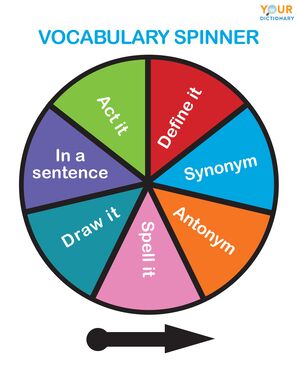
Print out this simple DIY spinner you can use to play a variety of vocabulary games. The simplest game is to use your vocabulary list and take turns spinning to see how players need to express the word. They may have to define it, draw it or even act it out!
Play Fun Word Board Games
There’s no shortage of word games available from online stores or big box stores. Public libraries often carry word games for patrons to play in groups. Fun and challenging word board games include:
- Balderdash
- Bananagrams
- Boggle
- Password
- Rummikub
- Scattergories
- Scrabble
- Taboo
- Word Slam
Play Fun Online Word Games
Make a personal challenge for yourself where you try to top your highest word game score. Fun online word games include:
- Quizzitive
- Text Twist
- Wheel of Fortune
- Word Cookies
- Wordscapes
- Words With Friends
Advertisement
Use a Word App
A tool like Word Finder is available on your computer or as a mobile app for your phone. You can use it as a resource when you get stuck in word games to see all the words that can be created from your letters. You can also check out lists of words that start with different letters to learn new words each day.
Use Those New Words
No matter which of these learning techniques you try, you're sure to improve your vocabulary if you dedicate some time to the process regularly. Once you find some new words, the next step is to use them whenever you can. How will you enhance your vocabulary today?